



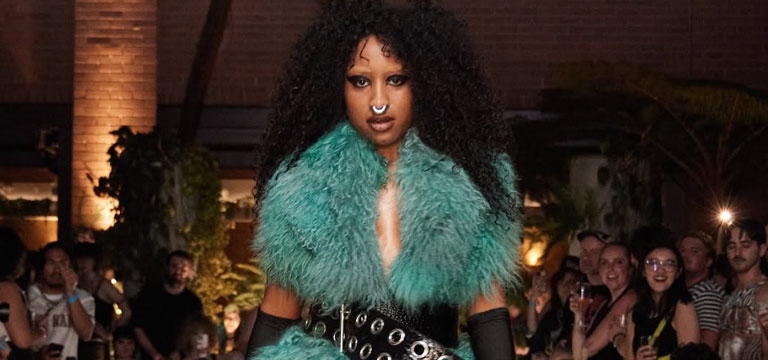
There was a time when I did not know where to go. It was when Ballroom found me, that I finally found home. And I truly hope by writing this, I can help someone else escape to this world too.
For those that do not know, the Ballroom scene is a Black and Latinx LGBTQ+ subculture that started in 1980s New York. It was born from trans women, in defiance, to colourism and racism of the mainstream pageant circuit. They created their own version, known as a Ball. These spaces blossomed into many categories where people can explore self expression and have expanded globally. It might be my closest experience to a queer utopia.
My first Ballroom experience
In this article:
The first time I entered a ball, it felt otherworldly… I was experiencing the aspects of fashion and social status of Hollywood’s hottest red-carpet events, with the familiarity of queer competition in Rupaul’s Drag Race. Spectators and competitors were surrounding me in fresh-off-the-runway designer garments and glamorous makeup looks just to dress for the occasion and/or their respective category. At any turn, you could start a conversation with high-status members in the scene, or someone experiencing their first ball too. It gave me such a rush.
People spend hours to even months, choreographing their performances and curating their effects (required fashion look per category) to ensure their best opportunity at winning a grand prize, legacy for their house (which we will get into later) and recognition from their peers. I honestly had not seen this anywhere else and after being a member since 2022, there is still no straightforward way to describe it.
Of course, no single article from a single person can encompass a full crash-course into the world of Ballroom. In fact, there is a lot of responsibility in supporting the integrity of its literature because it is ineffable. It’s not a community or culture that necessarily seeks coverage, in fact, it exists despite that. It is good to keep this in mind as Ballroom events can be wildly different from each other, and individual experiences on one event can vary wildly depending on how you attend.
I’m sure you have seen glimpses of Ballroom through the screen in Pose or Legendary, or under the stadium lights Voguing at Beyoncé’s Renaissance tour. As the scene continues to shine in the global spotlight, I love reminiscing on how the culture is more than an art form and can be a genuine day-to-day lifestyle. The camaraderie and community kinship stays one of the biggest highlights about Ballroom for me, as it can transform lives.
My Ballroom Family
View this post on Instagram
For many queer people, especially those rejected by biological relatives, Ballroom is a sacred place. My brother, Mercury La Sadé has been a professional dancer and artist for over five years, describes this as both a freedom and contradiction. “When I’m in the space, I feel safer,” they explain. “But there’s also this awareness that outside of that room, the world is not always safe for us. Ballroom creates this bubble where you can finally breathe.”
More than that, you can naturally form life-long bonds and even find a family. Mine is the House of La Sadé.
The Ballroom scene competes through teams, called Houses. These Houses are a reimagined version of a traditional nuclear family structure. Mothers, fathers, and other deemed family members mentor and guide others in the house and/or their respective scenes. More than competition teams, they become chosen families built on trust, care, and survival. Keep in mind, not everyone has to be in a house, to find family or compete. Some people who keep their unaffiliated house status (known as being a 007), still create notable family ties to community members and become staples in their respective categories.
Across Oceania, there are currently over twenty established houses and counting. Internationally, those numbers are likely in the hundreds, which means there is so much opportunity for up-and-coming prospects to find their way.
Joining House of La Sadé
View this post on Instagram
I spoke with a few of my siblings about how they came to join the House of La Sadé – and why they’ve stayed. As my sister Paradise, the self-styles Colombian Princess puts it, “Many famous artists use our culture for money, but… we are more than a show; we are a family. You can be the star, but we are the heaven where you are shining.”
And she is right.
“It is a place of healing,” Mercury says, “but you must know what your trauma is. Ballroom will not magically fix you unless you are willing to look inward too.”
Before Patty La Sadé became my Ballroom mother, I had spent years attending functions but was too terrified to walk a category. I convinced myself I simply did not want to compete, but in reality, I was paralysed by perfectionism and fear. I remember emotionally spiralling this realisation to Takudzwa one night (funnily enough, he’s also a La Sadé now) and how this mindset was bleeding into so many aspects of my life.
He looked at me and said, “It sounds like you need guidance. You should talk to Patty.”
So I did.
Patty had been in the scene long before I had found it. He was apart of Brisbane’s earliest Ballroom generation and notably House of Alexander’s debut. I was nervous to approach Patty, but it is a decision I have never regretted. Instead of judgement, Patty saw something in me long before I could see it in myself and since becoming his daughter, that has never changed.
For many people in Ballroom, this kind of love becomes transformational. My brother, Adonis La Sadé, who grew up on a farm in regional Queensland, describes Ballroom as filling “a wound” he had carried since childhood.
“I felt very alone growing up,” he says. “Then I discovered Ballroom and chosen family. I found people I didn’t need to explain myself to.”
Paradise La Sadé echoes that sentiment. My sister Paradise is known on the floor (see all of her grand prizes) and describes Ballroom as the first place that taught her emotional vulnerability instead of survival mode. “My Ballroom family taught me humility and how to handle emotions,” she says. “Things I used to think were weaknesses.”
The Emotional Transformation of Ballroom
View this post on Instagram
It’s wild to hear a crowd scream your name while embodying the most fearless version of yourself. But for me, the real gag is finding yourself reacting to life differently because of how Ballroom community has guided you in softness, discipline, and love. “Ballroom is where I feel my freest, my truest form,” Paradise says. “It’s where I go to charge my community battery. If I did not have Ballroom, I could still see myself running around in my old ways. It gave me the freedom to explore parts of life I was once stuck in.” So that self actualisation isn’t exclusive to the competition and performance of walking a Ball. It extends into a version of yourself that you haven’t given yourself permission to be.
And maybe that freedom is not always as grand as people imagine.
Sometimes freedom looks like a photoshoot where everyone finally feels beautiful in their own skin. Sometimes it sounds like laughter echoing in the streets after a function. Sometimes it is as simple as hearing somebody call you family and knowing they truly mean it.
In Colombia, Cobra tells me there is a saying: “God doesn’t live in heaven. He lives in the people you call family.” She smiles when she says it. “And this is an example of that.”
Hope and Trauma
Ballroom is not a perfect utopia. Like any space built by people carrying trauma. There are politics, egos, binaries, and wounds that do not disappear simply because the room feels safer than the outside world.
“Ballroom is for everyone to a degree,” Adonis explains. “There are areas that can be healing for your personal journey, but there are also things that can exacerbate your trauma. It depends on how you view yourself, the people around you, and whether you are developing yourself or letting Ballroom completely consume you.”
Yet despite this reality, Ballroom remains a profoundly hopeful place.
Paradise believes there is “a category, a corner, a chair and a cup for everyone” within the scene. And perhaps that is why so many people stay. Because once you find your people, the healing begins.
“I was finally able to let down hundreds of walls,” Paradise says. “Cry hundreds of tears with people. I do believe it is a place of healing if you find the right people to heal with.”
Mercury sees that healing as something political too.
“I feel like love is the only option for healing,” they say. “You never know who sees you and becomes inspired by your bravery and kindness.”
Finding your Ballroom scene
I often recommend that people attend community training when they’re interested in joining Ballroom, which is normally advertised online or through word of mouth. In Australia we have a few pages dedicated to local scenes in Brisbane, Melbourne, Sydney, and Perth. I am certain wherever you are globally will have options too. There’s always room from one more in this scene, so don’t be shy.
Again, I implore anyone who resonates with this piece to investigate your local Ballroom scene. I am so lucky, to have found it and to have found a family. I hope you take this as your formal invitation to escape into this world too.